

1. Phu Cam Conical Hat Village – A Traditional Craft in Hue
Hue is famous for its royal heritage, ancient architecture, traditional cuisine, and graceful cultural identity. Among the city’s most recognizable symbols is the Vietnamese conical hat, known locally as non la.
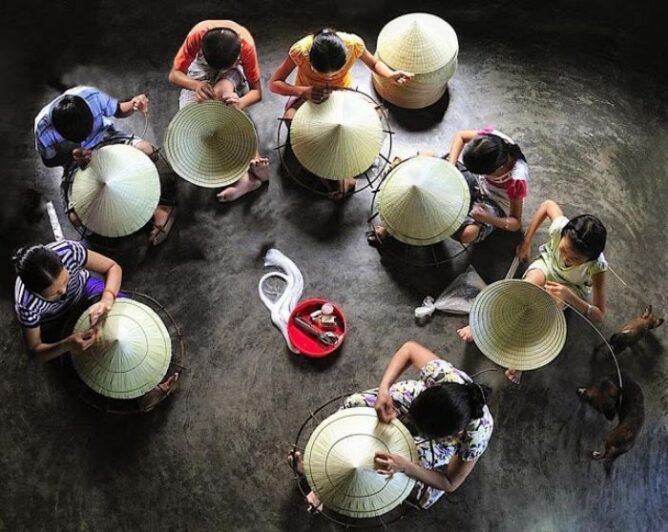
Located on the southern bank of the An Cuu River, Phu Cam Conical Hat Village is one of Hue’s traditional hat-making communities. For generations, local families have practiced the art of making conical hats, creating products that combine practical use with delicate craftsmanship.
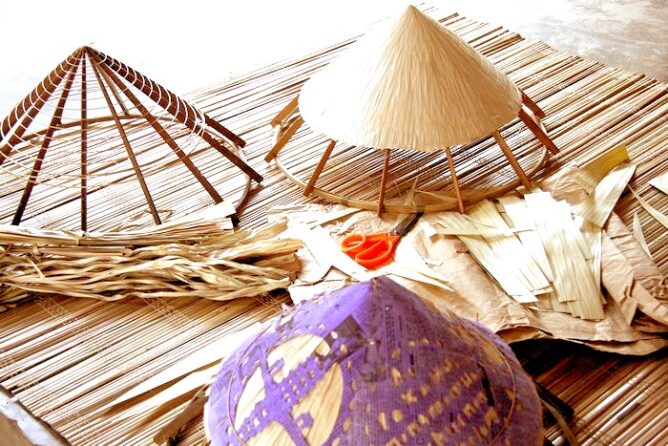
A traditional Hue conical hat may look simple, but its production requires careful preparation, skilled hands, and considerable patience. From selecting suitable palm leaves to shaping bamboo frames and stitching each layer, every stage contributes to the beauty of the finished product.
Although modern lifestyles have changed the demand for handmade hats, Phu Cam remains an important name in the story of Hue’s traditional handicrafts.
For travelers interested in local culture, visiting the Phu Cam area offers an opportunity to discover a lesser-known aspect of the ancient capital.
2. History of Phu Cam Conical Hat Village
The history of Phu Cam is closely connected to the development of Hue and its traditional communities.
According to local historical accounts, Phu Cam became known as a hat-making area many generations ago. The neighborhood was traditionally associated with the name Xom Non, meaning the Hat-Making Hamlet, reflecting the importance of this occupation in local life.
During the past, hat making was a familiar household activity. Many families participated in different stages of production, and the craft provided an additional source of income for local residents.
Phu Cam-made hats became appreciated for their lightweight structure, elegant shape, and careful finishing. Together with products from other traditional hat-making communities around Hue, they contributed to the reputation of Hue’s conical hats.
However, the arrival of modern headwear and changing consumer habits gradually reduced demand for handmade products. The number of households maintaining the traditional occupation has declined significantly.
Despite these challenges, the craft continues to be remembered as an important part of Phu Cam’s cultural identity.

3. How Are Traditional Phu Cam Conical Hats Made?
One of the most fascinating aspects of Phu Cam Conical Hat Village is the traditional process behind each handmade hat.
Unlike mass-produced headwear, a traditional non la requires several stages of preparation and careful manual work. The quality of the finished product depends on the materials, proportions, and experience of the artisan.
Selecting and Preparing Palm Leaves
The first step is choosing suitable leaves. Artisans look for leaves with the right age, color, and texture to ensure that they are flexible and durable.
After collection, the leaves are dried, softened, and carefully ironed flat. They are then trimmed to fit the shape of the conical frame.
Properly prepared leaves create the smooth surface and delicate appearance associated with Hue conical hats.
Creating the Bamboo Frame
The bamboo frame gives the conical hat its distinctive shape and structure.
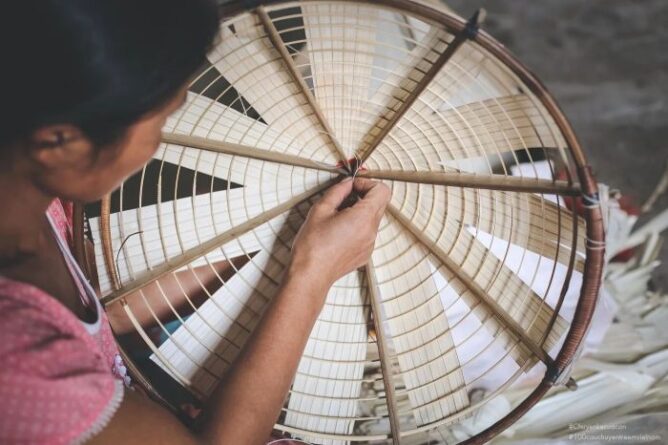
Thin bamboo strips are prepared and bent into circular rings of different sizes. These rings are arranged from the wide base to the narrow top, forming a balanced conical structure.
Traditional Hue hats are often made with 16 circular rings. The artisan must ensure that each ring is evenly shaped and positioned to create a symmetrical frame.
This stage requires experience and precision because the frame determines the overall proportions of the finished hat.
Arranging and Stitching the Leaves
Once the frame is complete, the prepared leaves are placed evenly over its surface.
Using a needle and thread, artisans stitch the leaves onto the bamboo rings. The stitches must be small, regular, and secure to keep the leaves in position while maintaining a neat appearance.
This is one of the most delicate stages of the process. It requires concentration, patience, and years of practice.
Finishing the Handmade Hat
After stitching, the artisan trims excess leaves, checks the shape, and adds finishing details such as the chin strap.
Some traditional hats also receive a protective treatment to improve their durability and resistance to moisture.
The completed product is lightweight, practical, and elegant – a simple object that reflects the craftsmanship of Hue.
4. What Makes Hue Conical Hats Special?
Vietnamese conical hats are familiar throughout the country, but Hue conical hats are particularly admired for their delicate appearance and cultural associations.
They are often characterized by:
-
A slim and elegant conical shape.
-
Lightweight construction.
-
Carefully selected and arranged palm leaves.
-
Neat stitching and balanced proportions.
-
Decorative details inspired by the culture and landscapes of Hue.
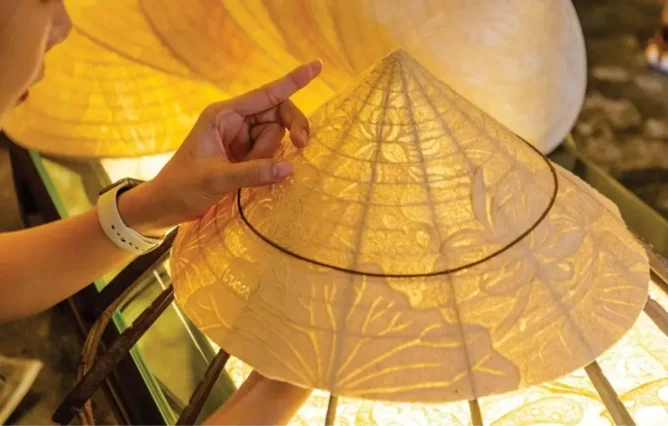
One of the most famous variations is the Non Bai Tho, or poetic conical hat.
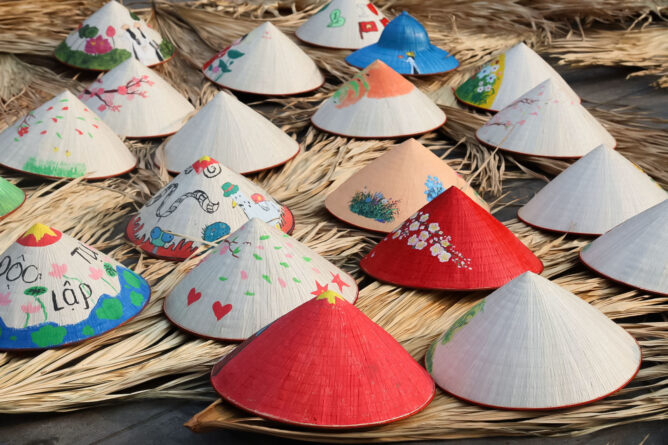
The poetic hat features verses, images, or decorative motifs placed between layers of leaves. When held against sunlight, these hidden details become visible, creating a distinctive artistic effect.
Common motifs include the Perfume River, Trang Tien Bridge, Ngu Binh Mountain, and traditional poems associated with Hue.
The poetic conical hat is more than an item used to protect the wearer from sunshine and rain. It represents the combination of traditional craftsmanship, literature, and the romantic character of Hue.
Phu Cam is among the communities associated with this wider tradition of Hue hat making, alongside other well-known craft villages in the region.
5. Phu Cam Conical Hats and the Image of Hue Women
The traditional conical hat has become closely associated with the graceful image of Hue women.
When paired with the Ao Dai, Vietnam’s traditional long dress, the non la creates an elegant appearance that has inspired generations of artists, poets, photographers, and travelers.
In the past, conical hats were part of everyday life. Women wore them when going to the market, working outdoors, or traveling through the streets of Hue.
Today, the combination of an Ao Dai and a conical hat remains a recognizable cultural image of the former imperial capital.
For many visitors, seeing this traditional outfit against the background of the Perfume River, Trang Tien Bridge, or the historic streets of Hue is a memorable cultural experience.
6. The Artisans Preserving Phu Cam’s Traditional Craft
Behind every handmade conical hat are the skills and dedication of local artisans.
Traditional hat making requires knowledge that cannot be acquired overnight. Artisans must understand the characteristics of different leaves, know how to prepare bamboo frames, and maintain consistent stitching throughout the production process.
However, the craft has faced increasing challenges as fewer young people continue the occupation and demand for handmade hats has changed.
A report published by Hue’s tourism information system described how the number of Phu Cam households involved in hat making had fallen considerably compared with the past.
Preserving the remaining skills and supporting local artisans are therefore important steps in maintaining this traditional craft.
Their work keeps alive more than a method of producing hats. It also preserves a part of the everyday cultural history of Hue.
7. Visiting Phu Cam Conical Hat Village in Hue
For travelers who want to explore Hue beyond its royal monuments, Phu Cam offers an interesting cultural stop.
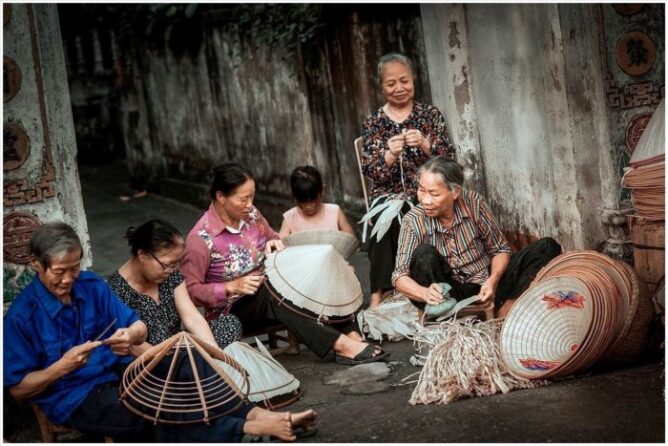
The neighborhood provides a glimpse into the traditional handicraft culture that once formed an important part of everyday life in the ancient capital.
Depending on the availability of local artisans, visitors may be able to:
-
Observe traditional conical hat-making techniques.
-
Learn about the materials used in producing non la.
-
Watch artisans prepare leaves and stitch the hats.
-
Discover the cultural meaning of the Hue poetic hat.
-
Purchase a traditional conical hat as a souvenir.
Because the number of active hat-making households has declined, Phu Cam should not be assumed to operate like a large, fully organized tourist craft village. Visitors who want to see artisans at work should arrange their visit in advance.
It is also important to ask permission before taking photographs inside private homes or workshops.
8. Nearby Attractions to Visit Around Phu Cam
After discovering Phu Cam’s traditional craft, visitors can continue exploring other cultural and historical attractions in Hue.
Phu Cam Cathedral
Phu Cam Cathedral is one of the most recognizable architectural landmarks in the area. Its impressive contemporary design and religious significance make it an interesting stop for visitors exploring the neighborhood.
Hue Imperial City
The Hue Imperial City is the former royal capital of the Nguyen Dynasty and one of Vietnam’s most important UNESCO World Heritage Sites.
Visitors can explore royal palaces, ceremonial courtyards, temples, and historic gates while learning about the country’s imperial history.
Perfume River
The Perfume River flows through the heart of Hue and is closely connected to the city’s history and daily life.
Visitors can enjoy a riverside walk, admire the traditional dragon boats, or take a boat trip to experience the peaceful scenery.
9. Why Should You Discover Phu Cam Conical Hat Village?
Phu Cam Conical Hat Village offers a different perspective on Hue’s cultural heritage.
While the Imperial City and royal tombs tell the story of Vietnam’s royal past, traditional handicraft communities reveal the everyday skills, livelihoods, and creativity of local people.
The non la is a simple but meaningful symbol of Vietnamese culture. It protects people from sunshine and rain while reflecting the beauty of traditional craftsmanship.
For international visitors, discovering Phu Cam provides a deeper understanding of Hue beyond its famous landmarks. It is an opportunity to appreciate the dedication of local artisans and the traditions that continue to shape the identity of the ancient capital.
Frequently Asked Questions About Phu Cam Conical Hat Village
1. Where is Phu Cam Conical Hat Village?
Phu Cam is located in central Hue, on the southern bank of the An Cuu River. It is historically known as one of the city’s traditional conical hat-making communities.
2. What is Phu Cam famous for?
Phu Cam is famous for its traditional Vietnamese conical hats, known as non la. The community has a long history of handmade hat production.
3. How are Phu Cam conical hats made?
Traditional hats are made by preparing palm leaves, shaping bamboo frames, arranging the leaves, stitching them by hand, and completing the finishing details.
4. What is a Hue poetic conical hat?
A Hue poetic conical hat, or Non Bai Tho, is a special type of conical hat featuring hidden poems or decorative images between its layers of leaves.
5. Can tourists visit Phu Cam Conical Hat Village?
Visitors can explore the Phu Cam neighborhood and may be able to observe traditional hat making when local artisans are available. It is advisable to arrange a visit in advance.
6. Can I buy a traditional conical hat in Hue?
Yes. Traditional Hue conical hats are available through local artisans, craft shops, markets, and souvenir stores. Visitors should ask about the origin and production method when purchasing handmade products.